 docs.healthdata.be
HD4RES v1 versus HD4RES v2
HD4RES v1
HD4RES is an application developed by healthdata.be and installed at Sciensano that allows the manager of the data collection to communicate with the data provider without knowing the identification of the patient. Data are sent automatically or by pressing a submit button to the central HD4RES application via eHealth. A mechanism of encryption is put in place assuring that nobody has access to the patient identifier and medical information except the data provider.
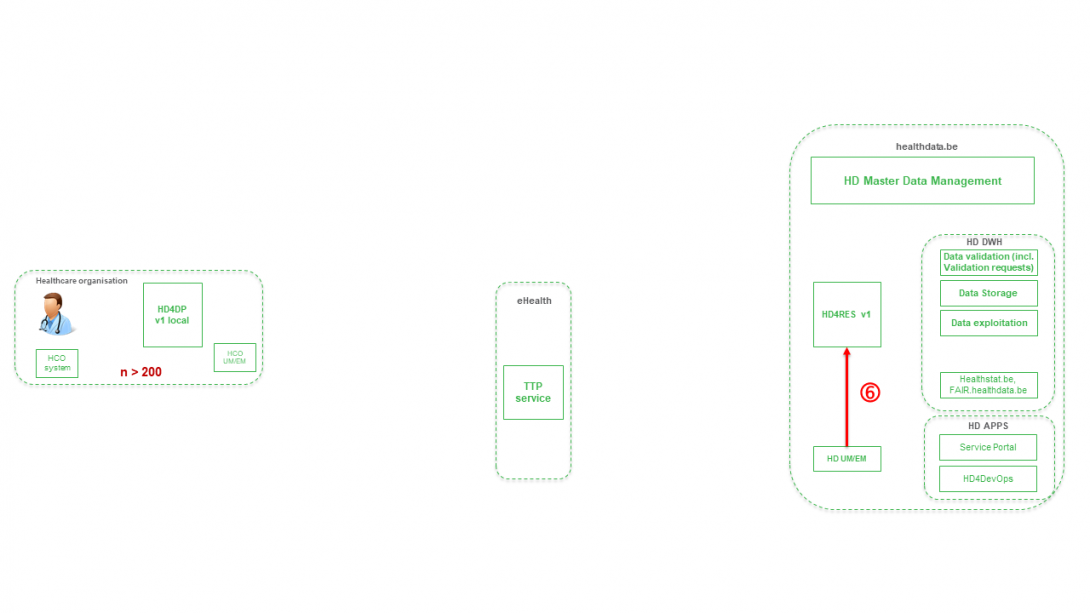
The researcher receives the data in a software component (Healthdata for Researchers: HD4RES) where he/she can monitor the status of his/her data collection, check the data and, if necessary, ask additional questions to the data provider. This in order to have errors in the data corrected.
To this end, healthdata.be sends a message back to the data provider via ehBox coding. This contains the encrypted data, together with the medical-scientific data that are encrypted with respect to the data provider. eHealth-platform takes care of the decryption of the encrypted data and delivers the data to the data provider.
HD4RES was a temporary solution. The challenge for HealthData in Architecture 1 was that all healthcare organisations and all healthcare professionals should be able to provide data in a structured and encoded way to the researcher. The records collected from the data providers could follow many itineraries, making monitoring a complex matter.
HD4RES v2
The main objective of HD4RES V2.0 is to simplify HD4RES.
Like in Architecture 1.0, the researcher will be able to monitor the Architecture 2.0 dataflow end-to-end. This will be possible at HD-DWH. HD4RES v.2 monitors:
- all data flows, not only HD4DP to HD
- all project related incidents and requests submitted via Service Portal
As HD4RES becomes part of the Quality Control tool, the application HD4RES as such disappears; it becomes now a block SAS eGuide in DWH that takes over that function.
Unlike in Architecture
n HD4RES v2, the researcher will have an overview and status of all (external and internal) dataflowsfor his/her projec