Access Manager E2E Actions
Access Manager E2E ActionsClick here to learn more about the concept "Access Manager".
This documentation is being updated regularly. We try to provide as correct, complete and clear as possible information on these pages. Nevertheless, if you see anything in the documentation that is not correct, does not match your experience or requires further clarification, please create a support ticket via our portal (https://healthdatabe.atlassian.net/servicedesk/customer/portals) or send us an e-mail via support.healthdata@sciensano.be to report this documentation issue. Please, do not forget to mention the URL or web address of the page with the documentation issue. We will then adjust the documentation as soon as possible. Thank you!How to become an Access Manager
How to become an Access ManagerThere are two ways to receive the status of Access Manager:
- If there is no Access Manager known or created within the organization concerned, the person appointed within the organization needs to file a ticket with the support service of healthdata.be at the Jira Service Management (JSM) portal.
- If an Authenticated User wants to become an Access Manager, this request should be directed to the Access Manager of the organization concerned. In case the Access Manager is not known to the Authenticated user, a ticket for this can be created with the support service of healthdata.be at the Jira Service Management (JSM) portal, who will then inform the Access Manager.
In case your organization is not defined in the EAM portal, create a ticket through the support service of healthdata.be at the Jira Service Management (JSM) portal to request the inclusion of your organization in the EAM portal
This documentation is being updated regularly. We try to provide as correct, complete and clear as possible information on these pages. Nevertheless, if you see anything in the documentation that is not correct, does not match your experience or requires further clarification, please create a support ticket via our portal Jira Service Management or send us an e-mail via support.hd@hda.fgov.be to report this documentation issue. Please do not forget to mention the URL of the page. We will then adjust the documentation as soon as possible. Thank you!Access Manager actions using the EAM interface
Access Manager actions using the EAM interfaceTable of contents
- Adding an own EAM account
- Adding an EAM account for another user
- Requesting approval of an EAM account for another user
- Approve an EAM account approval request
- Creating a new user inside EAM manually
- Adding an existing user to EAM and your organization manually
- Disabling an EAM account
- Enabling an EAM account
- Restoring an EAM account
- Blocking / unblocking an EAM user
- Promoting an Authenticated User to Access manager
- Demoting an Access manager to Authenticated user
- Viewing all users within the own organization(s)
Adding an own EAM account
Initial step:
Navigating to the HD EAM Portal and Access Manager profile
To log into our Entity Access Management system, you need to navigate to the https://eam.healthdata.be URL.

Logging in with itsme, eID
To log into the HD EAM Portal you need to click on the Login button on the top left of your screen.

Then select the Log in with eID button.
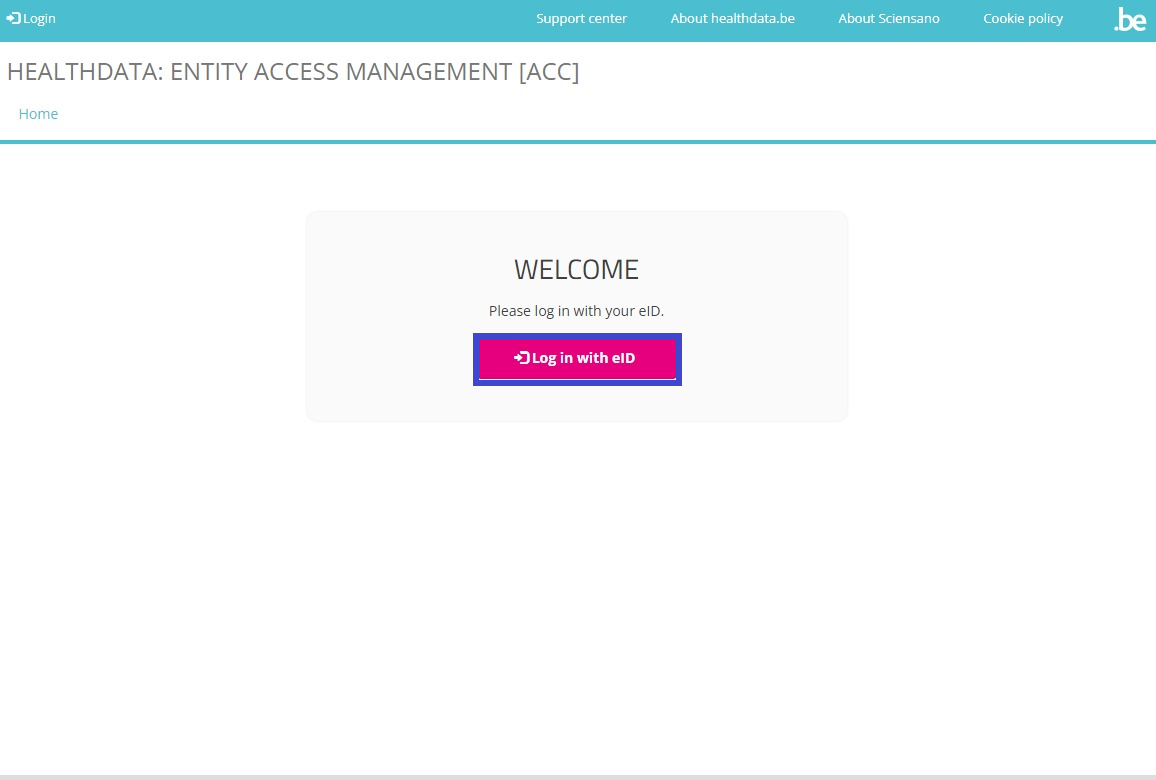
You will be redirected to the government's Federal Authentication Service (FAS), where you can log in with multiple digital keys with eID or digital identity.

If you choose to connect via itsme, you will need to enter your cell phone number.
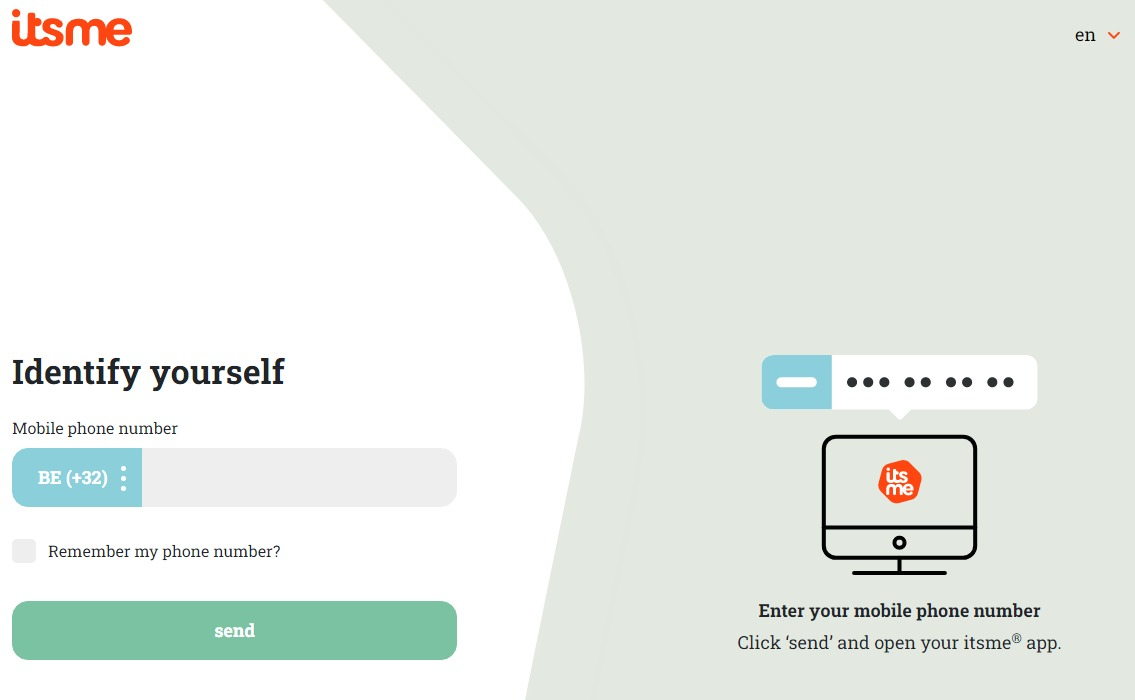
Follow the instructions on your mobile device via the itsme application.

Once the itsme login procedure has been completed, confirm by clicking the green profile validation button ("Profiel bevestigen" or "Confirmer le profil") to log in into the HD EAM system (see image below).
| NL | FR |
 |  |
You are now directed to the profile page of an Access Manager which displays the data you have shared by eID, itsme or another digital key.
The Access Manager profile page
The main My Profile screen shows the Personal information of the Access Manager as well as the Linked accounts of this profile. You can sort this overview by Account, Email or State.

Attention:
The accounts listed in Linked accounts are the Access Manager's OWN accounts, NOT the accounts to be managed by an Access Manager.
With the release of EAM 3.1 the Organisations item was added to the Personal information section, indicating the organization(s) the Access Manager is affiliated with. In this way, users can be traced back and managed by the Access Manager more easily.
Creating an own account
Selecting one of the accounts in the Linked accounts window enables you to manage grants for your own accounts and to carry out several advanced actions.
Clicking your name and e-mail address on the top left of the screen toggles a toolbar with the tabs View profile, Edit profile, My Accounts and Log out.
Select the My Accounts tab if you want to create an account.

Click on the Add new Account button at the bottom to create and provision a new account.

To provision the account, you complete the Account e-mail address and select an Organisation/Application. Click on the Save button.

The created account is automatically added to the list of accounts.

It will also appear in the Linked accounts section of the profile page.

Return to the User Matrix (recommended)
Adding an EAM account for another user
Preceding steps
Adding an EAM account for a another user
Click on Manage on the top left of the screen in order to reveal the EAM menu. Click on EAM Users.

Select the user you want to create an account for by clicking on first name, last name or SSIN.

Click on the Add new Account button.

To provision the account, you complete the Account e-mail address and select an Organisation/Application. Click on the Save button.

Upon returning to the User Details page you will see that the account has been added.

Next step: Request approval of the added EAM account here.
Return to the User Matrix (recommended)
Requesting approval of an EAM account for another user
Preceding steps
Requesting approval of the newly added EAM account
Select "n grant(s)" in the Grants column in order to open the Account:Manage grants page.

Click on the Request approval button.

The Account State immediately changes to Approval.

Requesting approval and subsequent approval of an account without any grants doesn't provide access to registries in a given HD application.
Go here to approve the approval request of a newly added account without grants.
If you want to add grants before requesting approval of / approving the account, go here (HD4DP v2) or here (healthstat.be) for the relevant procedures.
Return to the User Matrix (recommended)
Approving an EAM account approval request
Preceding steps
- Navigating to the HD EAM Portal and Access Manager profile
- Adding an EAM account for another user
- Requesting approval of the newly added EAM account
Approving an EAM account approval request
Click on Manage on the top left of the screen in order to reveal the EAM menu.

Select EAM Accounts followed by Approval.

Click on Approval to open the page with end-user accounts that are waiting to be approved:
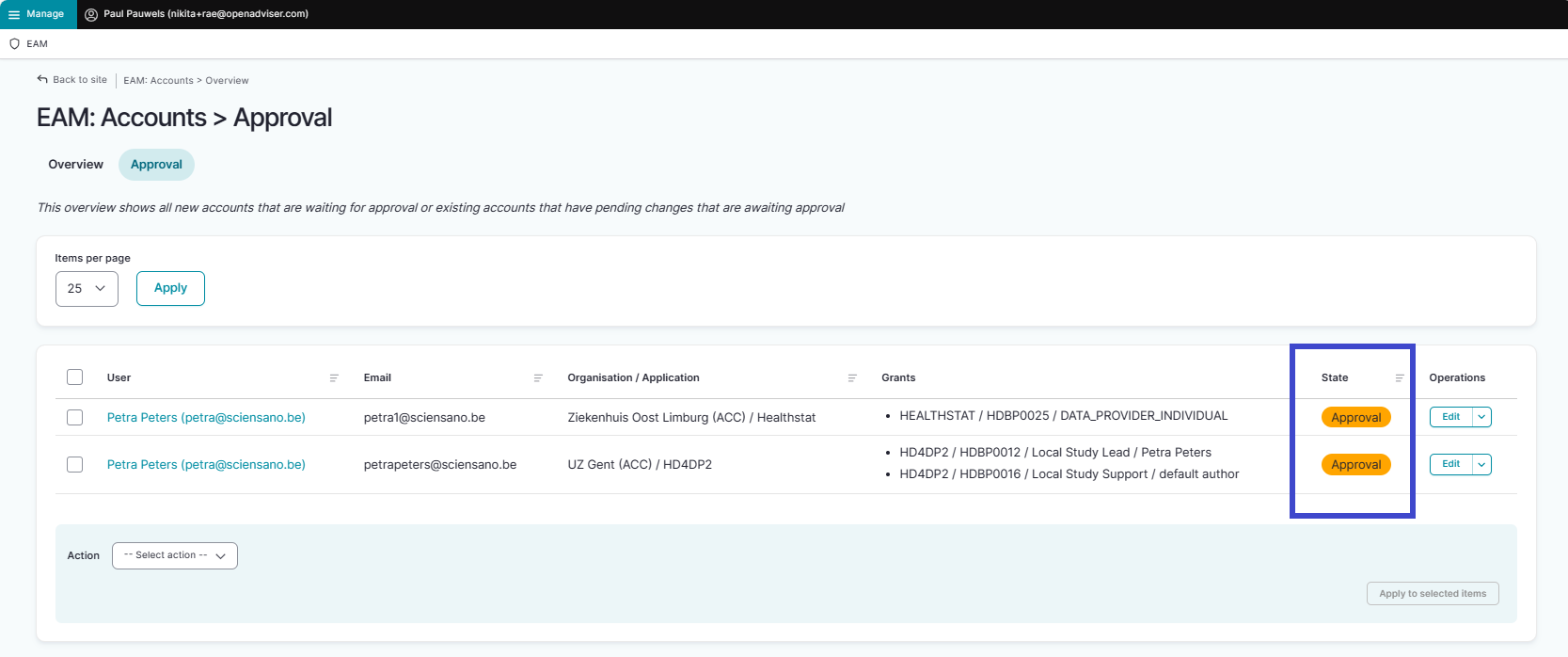
There are two ways to approve these account approval requests:
- Check the selection box of the relevant approval request and select the Approve action in the drop-down menu. Then, click on the Apply to selected item button to perform the action.

- Click on the Edit button in the Operations column for the relevant account ...

... and subsequently on the Approve button in the Account: Manage grants screen.

The Account State changes to Approved.

After this, a fulfilment process will start to run in the background, resulting in an Account State change to Published.
Performing a push action
If this change does not take place within a reasonable amount of time - usually up to three hours - the account could be updated by means of a "push".
Therefore, return to the accounts overview screen.

First, check the Approved account that needs to be pushed (1). Then, open the Action drop-down menu and select the Update account (push) option (2). Finally, validate this action by clicking on the Apply to selected items button (3).

In case the push action does not trigger the expected result, you need to contact our Support service.
NOTE: Immediate approval of a draft status EAM account using the EAM interface
Starting from the User details on the My Accounts page, select the newly added account that is still in the Draft state.
Select "n grant(s)" in the Grants column.
Click on the Approve button, thereby bypassing the Request approval request.

The Account State changes to Approved as seen in the image below.
Also here, a fulfilment process will start to run in the background, finally resulting in an account state change to Published. If needed, a push action can be performed.
Return to the User Matrix (recommended)
Creating a new user inside EAM manually
Preceding steps
Creating an EAM User manually
In case the Access Manager needs to upload just a few users, thereby not requiring the creation of a csv file for bulk upload, there is an option available to easily add new users to their own organization(s) and thus to the EAM system.
Click on Manage on the top left of the screen in order to reveal the EAM menu. Go to EAM Users and select Create user in the menu that pops up.

Fill out the requested information in the Create a new user screen.

Under Organisations on top of the screen you will find the organizations you, as an Access Manager, are currently managing. Select the organization for which you want to create a user by ticking the appropriate checkbox.
Furthermore, if you want to make this new user an Access Manager, you can activate the relevant setting.
Click on the Create button to submit the completed information. Next, when you return to the EAM Users overview via the EAM menu, you will see that the new user has been created and added to the list.
Return to the User Matrix (recommended)
Adding an existing user to EAM and your organization manually
Preceding steps
Adding an existing user manually
In case a user already exists in the EAM system, but is not yet connected to the organization, the Access Manager is not able to see this user in the Users overview. This is, for example, the case if a user has logged into the system via eID or itsme, but has not created an account yet.
These users are skipped when the Access Manager carries out a user bulk upload, and an error message ("user already exists") will be returned by the system.
To add the existing user manually, click on Manage on the top left of the screen and then on EAM Users. Select Add existing user in the menu that pops up.

In the Add an existing user screen fill out the requested information.

Under Organisations on top of the screen you need to select the organisation you manage as an Access Manager.
Then you need to provide the Primary Email and/or the Social Security Information Number (SSIN) of the existing user. The primary e-mail address should be the one that has been provided by the user when creating an account.
Click on the Add button to submit. Upon returning to the EAM Users overview via the EAM menu, you will notice that the existing user has retrieved and added to the list.
Return to the User Matrix (recommended)
Disabling an EAM account
Preceding steps
Disabling an EAM account
Click on Manage on the top left of the screen in order to reveal the EAM menu. Select EAM Accounts.

Scroll down the displayed list of accounts and tick the selection box of the account(s) you want to disable. Go to the bottom of the page and click on the Action toggle button to select Disable account. Then, click on the Apply to selected items button.

Confirm with the Execute action button

This action triggers an email notification for the Authenticated User to inform about the account being disabled. The user is no longer able to login with the credentials at hand, and needs to contact the Access Manager to have the account enabled again.
Return to the User Matrix (recommended)
Enabling an EAM account
Preceding steps
Enabling an EAM account
Click on Manage on the top left of the screen in order to reveal the EAM menu. Select EAM Accounts.

Scroll down the displayed list of accounts and tick the selection box of the account(s) you want to enable. Go to the bottom of the page and click on the Action toggle button to select Enable Account.

To complete the action, you need to click on the Execute action button.
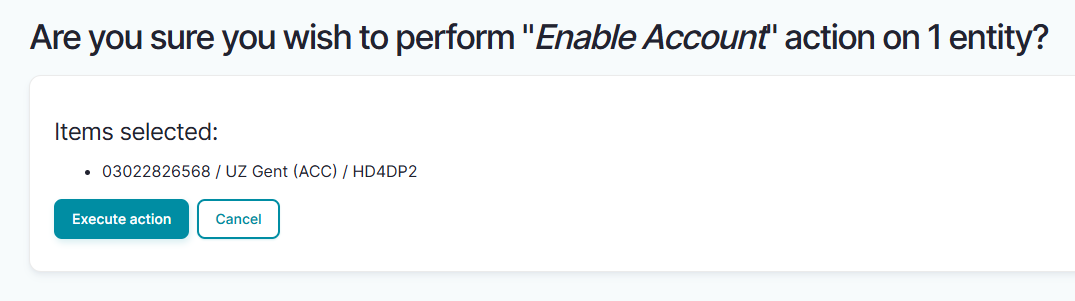
This action triggers an email being submitted to the Authenticated User with new credentials. All previously approved accesses will be restored.
Return to the User Matrix (recommended)
Restoring an EAM account
Preceding steps
Restoring an EAM account
Sometimes the Access Manager disables an EAM account to perform corrective actions without the Authenticated User of that account being able to login to the account.
Click on Manage on the top left of the screen in order to reveal the EAM menu. Select EAM Accounts.
Next, in the overview with the accounts of the Authenticated Users, click on the Edit button of the disabled account you wish to restore.
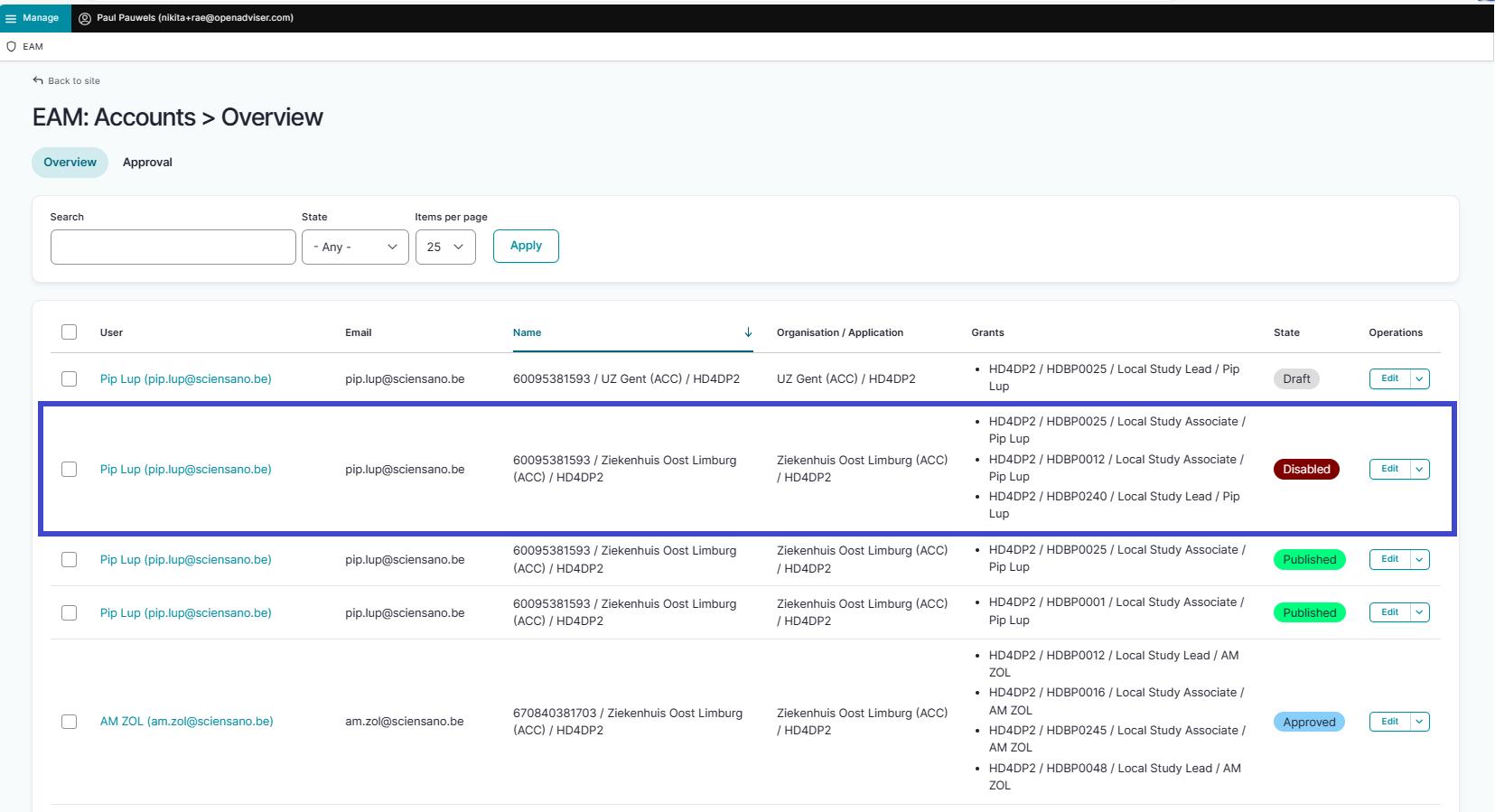
Next, to undo the Disabled state, you need to click on the Create New Draft button.
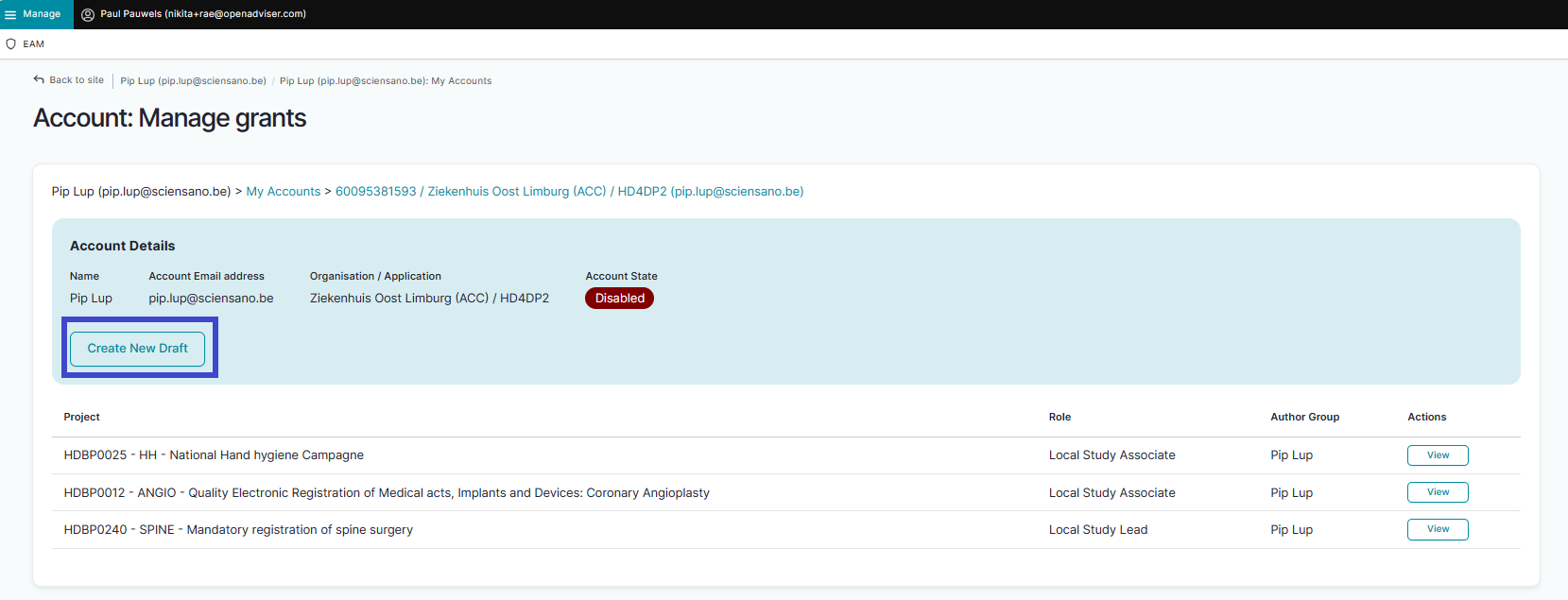
The Account State is restored to Draft, so that the Access Manager is able to carry out the necessary corrections on this EAM account.
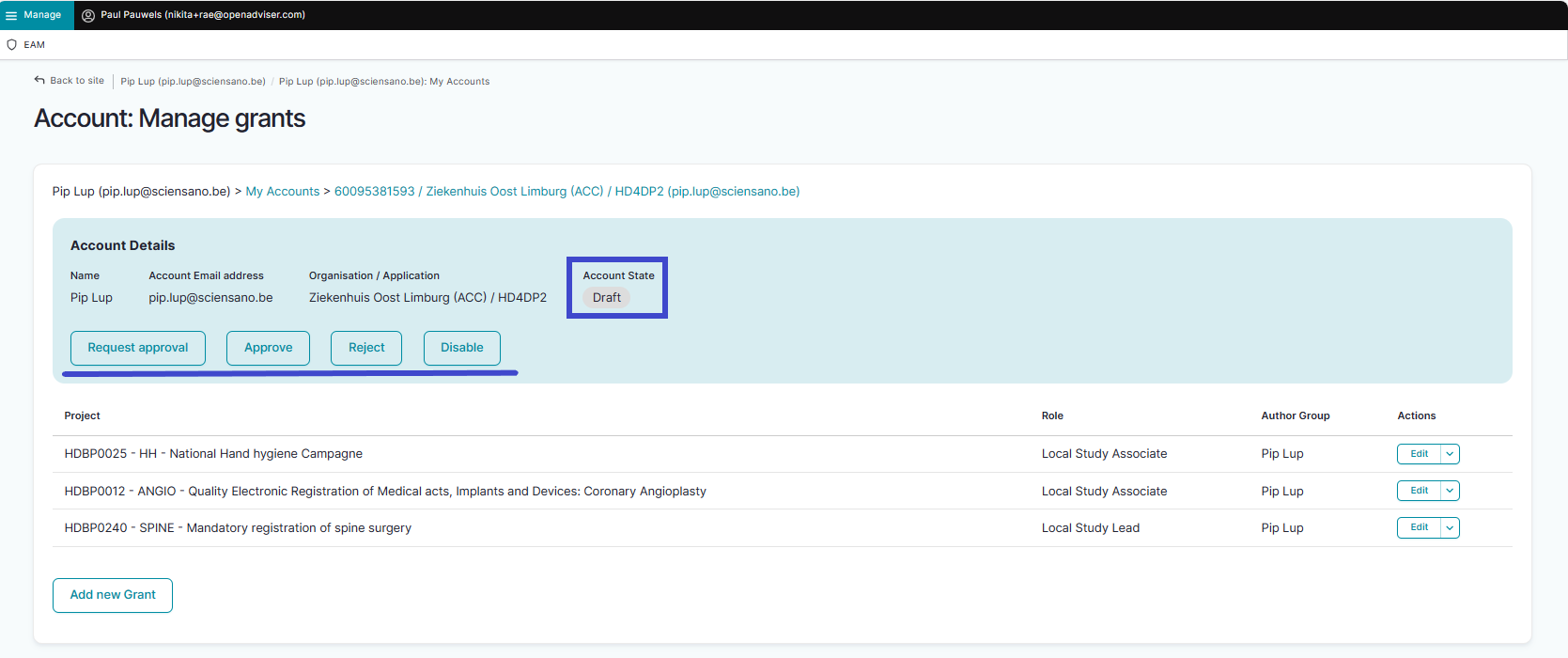
After having restored the Draft status, the Access Manager first needs to request for approval by clicking on the Request approval button. The approval request needs then to be approved. Click here to learn how to do this.
Return to the User Matrix (recommended)
Blocking / unblocking an EAM user
Preceding steps
Blocking an EAM user
Click on Manage on the top left of the screen in order to reveal the EAM menu. Select EAM Users.

In the displayed overview you check the box of the user(s) that you want to block. Select "Block the selected users" in the drop-down menu below the users overview. Finally, click on the Apply to selected items button.

If the action was carried out succesfully, you will see that the blocked users have the status disabled.

Unblocking an EAM user
In order to restore the status of the users to Enabled, the Access Manager needs to check the relevant boxes in the EAM Users overview, select the Unblock the selected users action and confirm with the Apply to selected items button.

The status of the unblocked users will have reset to Enabled.
Return to the User Matrix (recommended)
Promoting an Authenticated User to Access manager
Preceding steps
Promoting to Access Manager
Click on Manage on the top left of the screen in order to reveal the EAM menu. Click on EAM Users.

To promote a certain user to Access Manager, you need to select the relevant checkbox and go to the Action drop-down toggle at the bottom of the page.

Click on the toggle button and select Promote to Access Manager. Select Apply to selected items at the bottom right of the screen to perform the change of the user type to Access Manager.

In case the Authenticated User is associated with multiple organizations, you need to select the one for which the user needs to be promoted to Access manager and confirm as appropriate.

The change is published in the users overview.

Return to the User Matrix (recommended)
Demoting an Access Manager to Authenticated user
Preceding steps
Demoting to Authenticated User
Click on Manage on the top left of the screen in order to reveal the EAM menu. Click on EAM Users.
To demote an Access Manager (to user type of Authenticated User), you need to select the relevant checkbox in the displayed list and go to the Action drop-down toggle at the bottom of the page.

Click on the toggle button and select Demote Access Manager. Select Apply to selected items at the bottom right of the screen to perform the change of the user type to Access Manager.

On the security query screen you click on the Execute action button to perform the change.

The change is published in the users overview.

Return to the User Matrix (recommended)
Viewing all users within the own organization(s)
Preceding steps
Viewing all users within own organization(s)
Click on Manage on the top left of the screen in order to reveal the EAM menu. Select EAM Users.
The page shown displays an overview of all users for the organization(s) that are within the scope of the Access Manager.

To support the Access Managers in their tasks, the Users overview has been improved on following aspects:
- the EAM Users overview can be sorted by First name, Last name, Primary email, SSIN, EAM role and Status;
- the EAM Users overview can be exported as a csv format file;
Return to the User Matrix (recommended)
This documentation is being updated regularly. We try to provide as correct, complete and clear as possible information on these pages. Nevertheless, if you see anything in the documentation that is not correct, does not match your experience or requires further clarification, please create a support ticket via our portal Jira Service Management or send us an e-mail via support.hd@hda.fgov.be to report this documentation issue. Please do not forget to mention the URL of the page. We will then adjust the documentation as soon as possible. Thank you!Access Manager actions using CSV Upload
Access Manager actions using CSV UploadTable of contents
- Creating EAM Users via bulk upload
- Creating EAM Accounts and adding grants via bulk upload
- Exporting EAM Users in batch
- Exporting EAM Accounts in batch
Creating EAM Users (own orgs)
Video available here
Full tutorial available here
Preceding steps
Creating EAM Users via bulk upload
Click on Manage on the top left of the screen in order to reveal the EAM menu. Click on EAM Users and then Bulk upload.
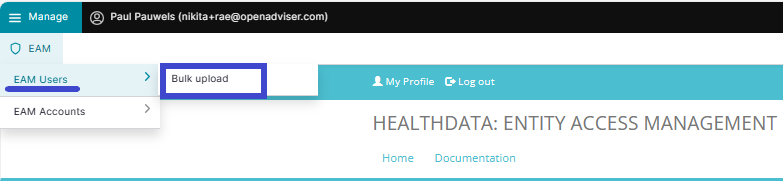
On the Users Batch Creation page, select a valid .csv file on your system to upload.
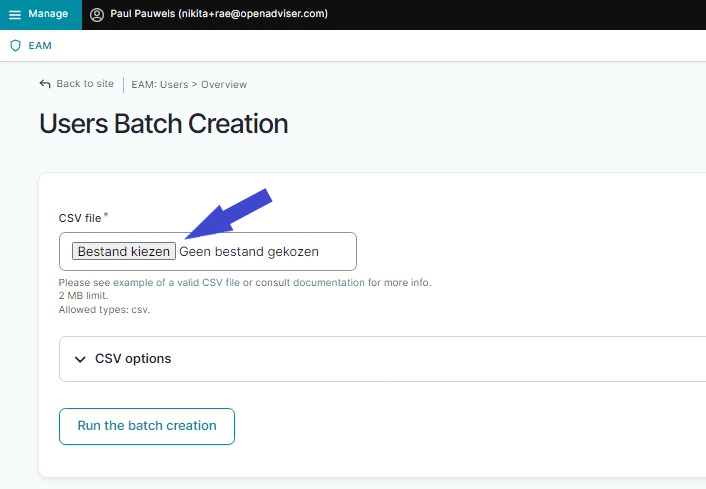
If you don't have a valid file available, use the following example file:
Use the schema file to validate the csv example file:
ATTENTION:
User roles and corresponding values
To complete the value for the field “role”, 2 different variables are possible:
- access_manager
- default
Additional tips:
- If the user already exists, the line will be skipped.
- Avoid using Excel as this can lead to unwanted formatting.
- First_name and Last_name need to be capitalized.
- Make sure that you have placed the quotation marks correctly. If the values have no comma, you can also leave out quotes.
Abbreviations used in csv bulk upload files
- ssin: Social Security Identification Number - Numéro d’identification de la sécurité sociale (NISS) - IdentificatieNummer Sociale Zekerheid (INSZ)
- org_nihdi: National Institute for Health and Disability Insurance number of your organization (RIZIV/INAMI number)
- nihdi: your personal National Institute for Health and Disability Insurance number (RIZIV/INAMI number)
- app: application such as HD4DP, Healthstat
- project_code: code of the healthdata.be Business Project, e.g. HDBP0001 for Belgian Cystic Fibrosis Registry (BCFR)
Now, run the batch creation by clicking on the corresponding button.
Return to the EAM users overview page to verify the bulk uploaded user list.
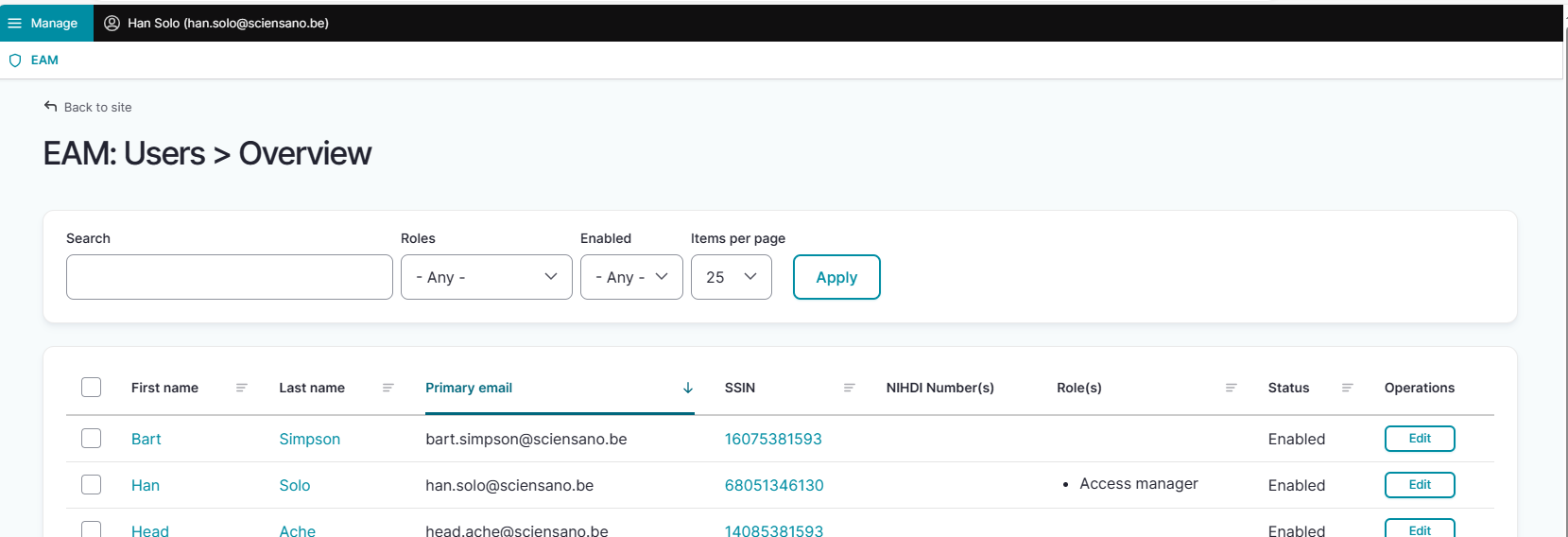
Attention:
Sometimes users that are uploaded in bulk are being skipped. Investigation of the relevant error message reveals that "the user already exists". The Access Manager can now choose to add these existing users manually.
Click here for the description of this process.
Return to the User Matrix (recommended)
Creating EAM accounts and adding grants via bulk upload
Full tutorial available here
Preceding steps
Creating EAM accounts via bulk upload
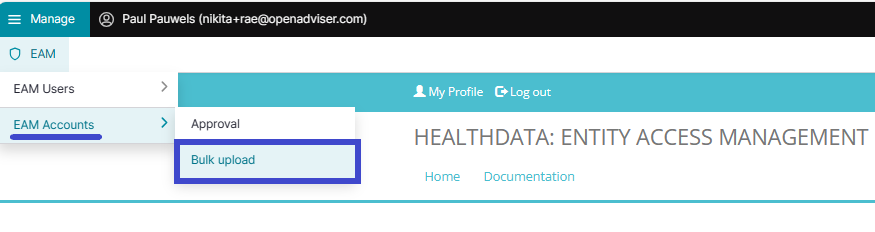
Click on Manage on the top left of the screen in order to reveal the EAM menu. Click on EAM Accounts and then Bulk upload.
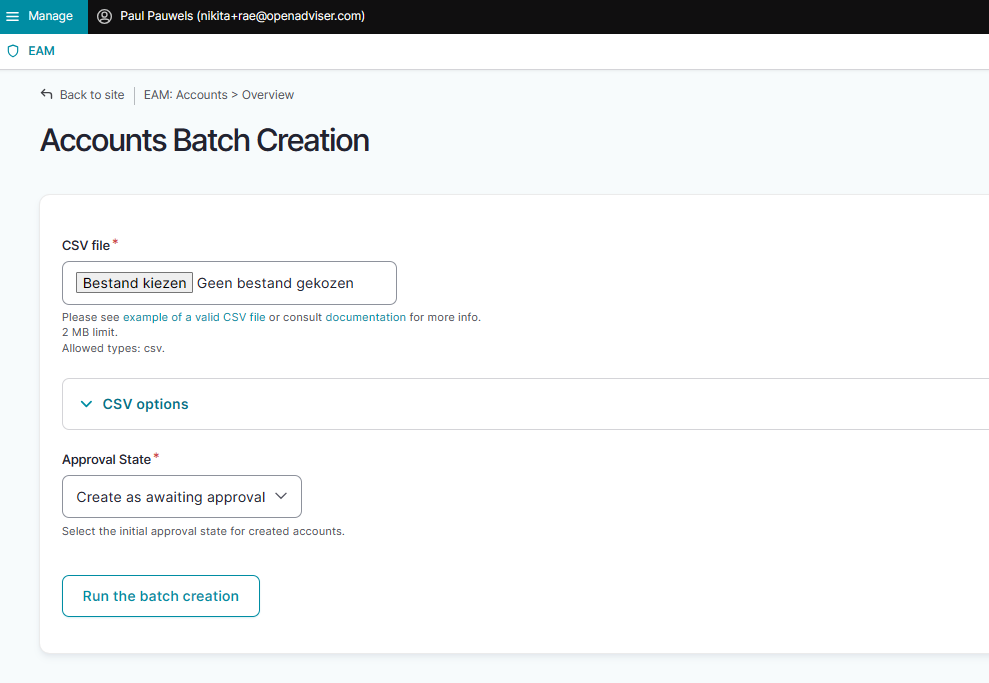
On the Accounts Batch Creation page, select a valid .csv file on your system to upload.
If you don't have a valid file available, use the following example file:
Use the schema file to validate the csv:
ATTENTION:
User roles and corresponding values
To complete the value for the “role” field for HD4DP2, 3 different variables are possible:
- "1" = Local Study Lead
- "2" = Local Study Associate
- "3" = Local Study Support
Make sure to use "hd4dp2" as value for the "app" field, since roles "1", "2", and "3" are typical roles for the HD4DP2 data collection application.
To complete the value for the “role” field for Healthstat.be, 4 different variables are possible:
- DATA_PROVIDER_HOSPITAL = Data Provider/Hospital
- DATA_PROVIDER_INDIVIDUAL = Data Provider/Individual
- SPONSOR_SPONSOR = Sponsor/Sponsor
- SPONSOR_INDIVIDUAL = Sponsor/Individual
Make sure to use "healthstat" as value for the "app" field, since roles "Data Provider" and "Sponsor" combined with data levels "Hospital" and "Individual" are typical for the Healthstat.be data reporting and visualization application.
Additional csv bulk upload tips
- When the "role" field has value "1" or "2", the "authorgroup" field should be left empty. Pay attention to this when changing "role" field from value "3" to "1" or "2".
- When adding a user to role "3", the author group needs to be defined and needs to exist, or the line will be skipped. To guarantee a successful bulk upload of an extensive csv file, you want to place the accounts with role 3 at the end of the list to be uploaded. The accounts with role "1" and "2" are imported first, and thus prefilling the author group list with First_name and Last_name prior to importing the accounts with role "3".

- First_name and Last_name need to be capitalized.
- When adding more than one project code, use pipes to separate the codes.
- If the user does not exist, the line will be skipped.
- Avoid using Excel as this can lead to unwanted formatting of the csv file.
- Make sure that you have placed the quotes correctly. If the values have no comma, you can also leave out quotes.
Abbreviations used in csv bulk upload files
- ssin: Social Security Identification Number - Numéro d’identification de la sécurité sociale (NISS) - IdentificatieNummer Sociale Zekerheid (INSZ)
- org_nihdi: National Institute for Health and Disability Insurance number of your organization (RIZIV/INAMI number)
- nihdi: your personal National Institute for Health and Disability Insurance number (RIZIV/INAMI number)
- app: application such as HD4DP, Healthstat
- project_code: code of the healthdata.be Business Project, e.g. HDBP0001 for Belgian Cystic Fibrosis Registry (BCFR)
Next, make a selection in the Approval State menu shown below.

- Create as awaiting approval: With this option the accounts will receive the status Approval and will be set ready for the Access Manager to be Approved. Go to next step for approval of the access grants.
- Create as pre-approved: With this option the accounts will receive the status Approved and will be uploaded directly without further input from the Access Manager (e.g. confidence in content quality is very high)
Finally, run the batch creation by clicking on the corresponding button.
Return to the User Matrix (recommended)
Exporting EAM Users in batch
Preceding steps
Export EAM users in batch
With the release of EAM version 3.1 you will be able to export the users in the overview by clicking on the CSV Export Users button on the top right of the screen.
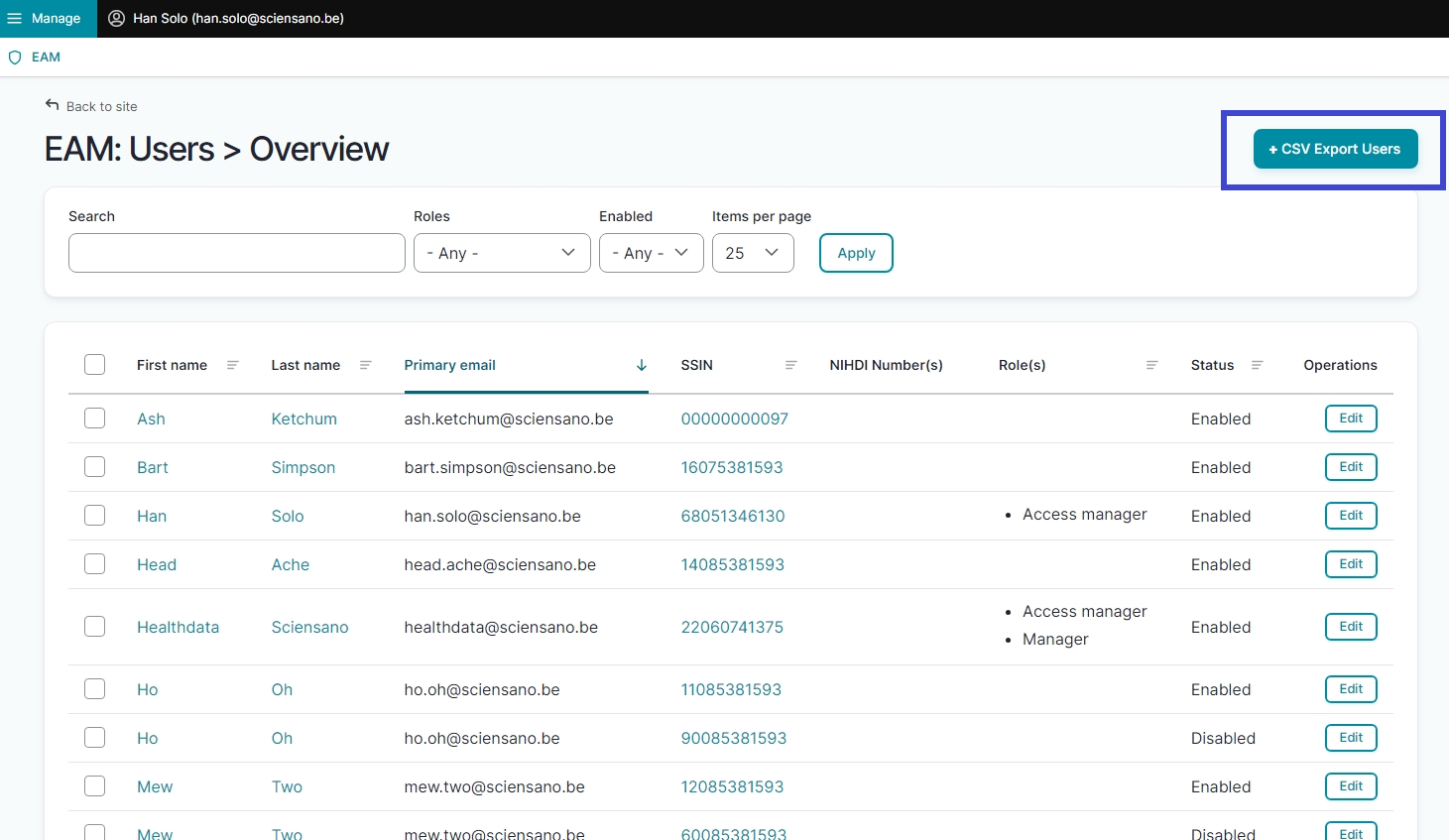
The list will be downloaded in .csv format, including following headers: ssin, email, org_nihdi, app, project_code,role, authorgroup. This format and structure allow for editing of the user information and reupload.
Return to the User Matrix (recommended)
Exporting EAM Accounts in batch
Preceding steps
Export EAM users in batch
With the release of EAM version 3.1 you will be able to export the accounts in the overview by clicking on the CSV Export Accounts button on the top right of the screen.
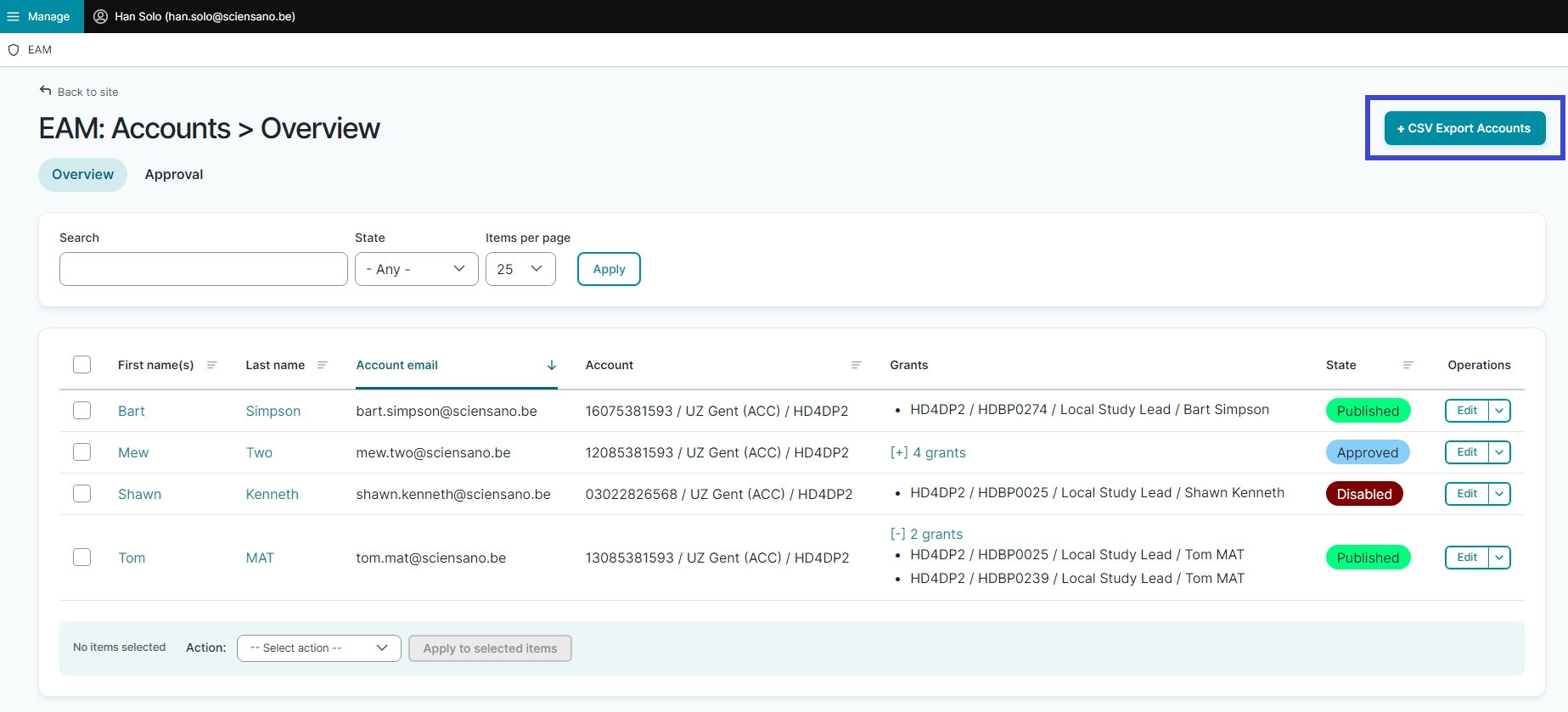
The list will be downloaded in .csv format straight to your selected device, including following headers: ssin, email, org_nihdi, app,project_code, role, authorgroup.
Return to the User Matrix (recommended)
This documentation is being updated regularly. We try to provide as correct, complete and clear as possible information on these pages. Nevertheless, if you see anything in the documentation that is not correct, does not match your experience or requires further clarification, please create a support ticket via our portal Jira Service Management or send us an e-mail via support.hd@hda.fgov.be to report this documentation issue. Please do not forget to mention the URL of the page. We will then adjust the documentation as soon as possible. Thank you!Access Manager actions for a project in HD4DP2 using the EAM interface
Access Manager actions for a project in HD4DP2 using the EAM interfaceTable of contents
- Adding access grants with the role of Local Study Lead, Local Study Associate or Local Study Support (for an author group "Author Group")
- Requesting approval of access grants with the role of Local Study Lead, Local Study Associate or Local Study Support (for an author group "Author Group")
- Approving access grants with the role Local Study Lead, Local Study Associate, or Local Study Support (for an author group "Author Group")
- Disabling an EAM account
- Resetting a password of an EAM account
- Changing access grants to the role of Local Study Lead, Local Study Associate or Local Study Support (for an author group "Author Group")
- Requesting access grants change approval to the role of Local Study Lead, Local Study Associate or Local Study Support (for an author group "Author Group"
- Approving access grants change to the role of Local Study Lead, Local Study Associate or Local Study Support (for an author group "Author Group")
- Removing access grants from an EAM account
- Changing the author group (Local Study Support)
- Viewing all accounts of all users within the own organization(s)
- Viewing own accounts
Adding access grants with the role of Local Study Lead, Local Study Associate or Local Study Support (for an author group "Author Group")
Preceding steps
Provisioning a new EAM account and adding grants for HD4DP2
Click on Manage on the top left of the screen in order to reveal the EAM menu. Select EAM Users.

Select a user from the displayed overview for whom you want to create an account with provisioning and addition of grants. To do so, click on the corresponding First name, Last name or SSIN.
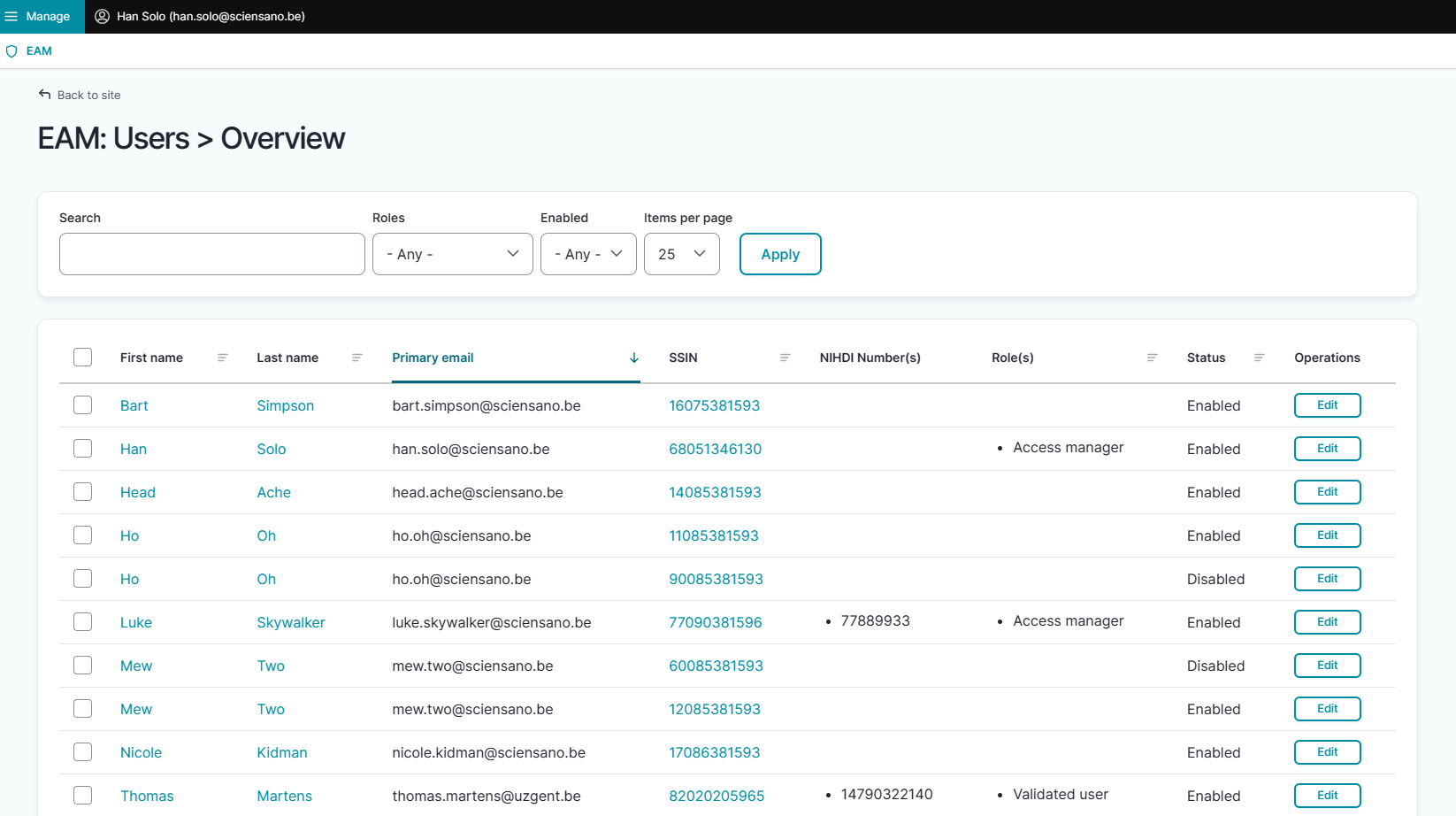
ATTENTION: Authenticated Users that do not yet appear in the list have either to register via the FAS service and create an account (Authenticated User action) or have to be added via Bulk upload (Access Manager action) first.
Select the Add new Account button in the displayed My Accounts page.

Complete the fields in the Add a new account pop-up window and click on the Save button to add the completed account.

To add the grants, select "n grant(s)" for the desired account.

Click on the Add new Grant button.

Select the desired project and the role of Local Study Lead, Local Study Associate or Local Study Support in the Add a new grant pop-up window.

When selecting Local Study Support, you also need to select an Author group. Confirm with the Save button.

Upon returning to the Account: Manage grants page you will notice that the grant is added to your account, which is still in the Draft state.

Next step: Go here to request approval of the access grants added to the account.
Return to the User Matrix (recommended)
Requesting approval of access grants with the role of Local Study Lead, Local Study Associate or Local Study Support (for an author group "Author Group")
Preceding steps
- Navigating to the HD EAM Portal and Access Manager profile
- Provisioning a new EAM account and adding grants for HD4DP2
Requesting EAM account approval
Next step is to request approval of the newly added account with grants, thus enabling the Authenticated User to access the specified project(s) in a given application (HD4DP2, Healthstat.be ...).
Click on the Request approval button.
The status immediately changes to Approval.
The Access Manager will be notified of your request via e-mail. The Access Manager will then need to take the appropriate action. This can take multiple hours. Upon confirmation the Account state will change to Approved.
Next step: Access Manager's approval of the access grants as described here.
Return to the User Matrix (recommended)
Approving access grants with the role of Local Study Lead, Local Study Associate or Local Study Support (for an author group "Author Group" (own orgs)
Video available here
Preceding steps
- Navigating to the HD EAM Portal and Access Manager profile
- Provisioning a new EAM account and adding grants for HD4DP2
- Requesting EAM account approval
Approving an EAM account approval request
Click on Manage on the top left of the screen in order to reveal the EAM menu.
Select EAM Accounts followed by Approval.
Click on Approval to open the page with end-user accounts that are waiting to be approved:
There are two ways to approve these account approval requests:
- Check the selection box of the relevant approval request and select the Approve action in the drop-down menu. Then, click on the Apply to selected item button to perform the action.
- Click on the Edit button in the Operations column for the relevant account ...
... and subsequently on the Approve button in the Account: Manage grants screen.
The Account State changes to Approved.
After this, a fulfilment process will start to run in the background, resulting in an Account State change to Published.
Performing a push action
If this change does not take place within a reasonable amount of time - usually up to three hours - the account could be updated by means of a "push".
Therefore, return to the accounts overview screen.
First, check the Approved account that needs to be pushed (1). Then, open the Action drop-down menu and select the Update account (push) option (2). Finally, validate this action by clicking on the Apply to selected items button (3).
In case the push action does not trigger the expected result, you need to contact our Support service.
Return to the User Matrix (recommended)
Disabling an EAM account (own orgs)
Preceding steps
Disabling an EAM account
Click on Manage on the top left of the screen in order to reveal the EAM menu. Select EAM Accounts.
Scroll down the displayed list of accounts and tick the selection box of the account(s) you want to disable. Go to the bottom of the page and click on the Action toggle button to select Disable account. Then, click on the Apply to selected items button.
Confirm with the Execute action button
This action triggers an email notification for the Authenticated User to inform about the account being disabled. The user is no longer able to login with the credentials at hand, and needs to contact the Access Manager to have the account enabled again.
Return to the User Matrix (recommended)
Resetting a password of an EAM account
Video available here
Preceding steps
Resetting the password of an EAM account
Click on Manage on the top left of the screen to reveal the EAM menu. Select EAM Accounts.

Scroll down the overview with the accounts and tick the selection box of the account(s) for which you want to reset the password.

Go to the bottom of the page and click on the Action toggle button to select Reset password.

To complete the action, you need to click on the Execute action button.

This action triggers an e-mail to the end-user containing the new credentials.
Return to the User Matrix (recommended)
Changing access grants to the role of Local Study Lead, Local Study Associate or Local Study Support (for an author group "Author Group")
Preceding steps
Changing access grants
Click on Manage on the top left of the screen to reveal the EAM menu. Select EAM Accounts.
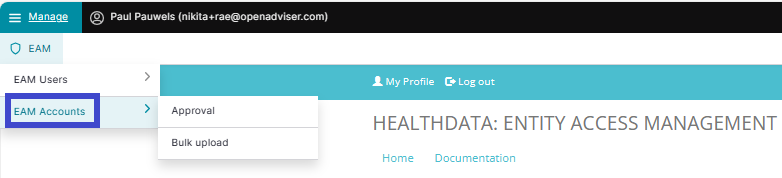
Select an account for a project in an application for which the role, author group (HD4DP2) or data/level (healthstat.be) need to be changed.

When you have set up a new account, it will have the draft state, which allows for adding and editing grants.
However, in the following four scenarios you need to make sure that the account state is set to Draft first before you can start to edit the grants (project, role).
- When the account is in the Published state, do the following:
Go to the EAM: Accounts overview and click on the Edit button next to Published.

In the Account: Manage grants screen you select the Create New Draft button.

The Account State will be set to Draft.
- When the account is in the Disabled state, do the following:
Go to the EAM: Accounts overview and click on the Edit button next to Published.

In the Account: Manage grants screen you select the Create New Draft button.

The Account State will be set to Draft.
- When the account is in the Approved state, do the following:
Go to the EAM: Accounts overview and click on the Edit button next to Disabled.

In the Account: Manage grants screen you select the Disable button.

Select the Create New Draft button.

The Account State will be set to Draft.
- When the account is in the Approval state, do the following:
Go to the EAM: Accounts overview, select the Approval tab and click on the Edit button next to Approval.

In the Manage grants screen you select the Disable button.

Select the Create New Draft button.

The Account State will be set to Draft.
When the account state is finally set to Draft, click on the Edit button for the project and role you wish to change.

Change the set role to the desired one. Below an example for the HD4DP2 application.

When changing role to Local Study Support (HD4DP2), you also need to select an Author group.
Confirm with the Save button. When returning to the Account: Manage grants page you will notice that the grant is added to your account. This will still be in the Draft state.

You have now changed the access grants for a project in HD4DP2 with the role of Local Study Lead, Local Study Associate or Local Study Support (for an author group).
Next step: Request for approval of the access grants change as described here.
Return to the User Matrix (recommended)
Requesting access grants change approval to the role of Local Study Lead, Local Study Associate or Local Study Support (for an author group "Author Group")
Preceding steps
Requesting for approval of changed access grants
To request for approval of the access grants change for a project in an application, you need to click on the Request approval button.

The Account State changes to Approval.

The updated state is also visible in the accounts overview.

Next step: The Access Manager approves the access grants change approval request as described here.
Return to the User Matrix (recommended)
Approving access grants change to the role of Local Study Lead, Local Study Associate or Local Study Support (for an author group "Author Group"
Video available here
Preceding steps
- Navigating to the HD EAM Portal and Access Manager profile
- Changing access grants
- Requesting for approval of changed access grants
Approving the change of access grants
To approve the modified access grants, click again on the relevant Edit button in order to return to the Account: Manage grants page.
Now, click the Approve button.

The Account State immediately changes to Approved, which will also be visible in the EAM accounts overview.

Return to the User Matrix (recommended)
Removing access grants from an EAM account
Preceding steps
Removing access grants
Click on Manage on the top left of the screen in order to reveal the EAM menu. Select EAM Accounts.
Next, select an account for which you want to remove the grants (HD4DP2 project and role).
When you have set up a new account, it will display the draft state, which allows for adding and editing grants.
However, in the following four scenarios you need to make sure that the account state is set to Draft first before you can start to edit Project/Role (Grant).
- When the account is in the Published state, do the following:
Go to the EAM: Accounts overview and click on the Edit button next to Published.
In the Manage grants screen you select the Create New Draft button.
The Account State will be set to Draft.
- When the account is in the Disabled state, proceed as follows:
Go to the EAM: Accounts overview and click on the Edit button next to Published.
In the Manage grants screen you select the Create New Draft button.
The Account State will be set to Draft.
- When the account is in the Approved state, do the following:
Go to the EAM: Accounts overview and click on the Edit button next to Disabled.
In the Manage grants screen you select the Disable button.
Select the Create New Draft button.
The Account State will be set to Draft.
- When the account is in the Approval state, do the following:
Go to the EAM: Accounts overview, select the Approval tab and click on the Edit button next to Approval.
In the Manage grants screen you select the Disable button.
Select the Create New Draft button.
The Account State will be set to Draft.
When the Account State is finally set to Draft, click on the toggle of the Edit button for the grant (HD4DP2 project and role) you want to remove.

Click on the Remove option to remove the relevant grant from the EAM account.
Return to the User Matrix (recommended)
Changing the author group (Local Study Support)
Preceding steps
Changing the author group
Click on Manage on the top left of the screen to reveal the EAM menu. Select EAM Accounts.
Select an account for a project in HD4DP2 with role Local Study Support from the displayed overview for which you want to change the author group.

First, make sure that the account state is Draft or Published. Editing grants, such as changing an author group, is not possible when the selected account is in the Approval or Approved state. Go here to learn how to reset your account back to the Draft state.
When the Account State is finally set to Draft, click on the Edit button for a project in HD4DP2 for which you wish to change the author group. Next, select the Edit button for the project and role you want to change.

In the Edit Grant window, select another author group from the drop-down list.

The Author group change is confirmed and shown on the Account: Manage grants page.

Return to the User Matrix (recommended)
Viewing all accounts of all users within the own organization(s)
Preceding steps
Viewing all accounts of all users for the different applications
Click on Manage on the top left of the screen in order to reveal the EAM menu. Select EAM Accounts.
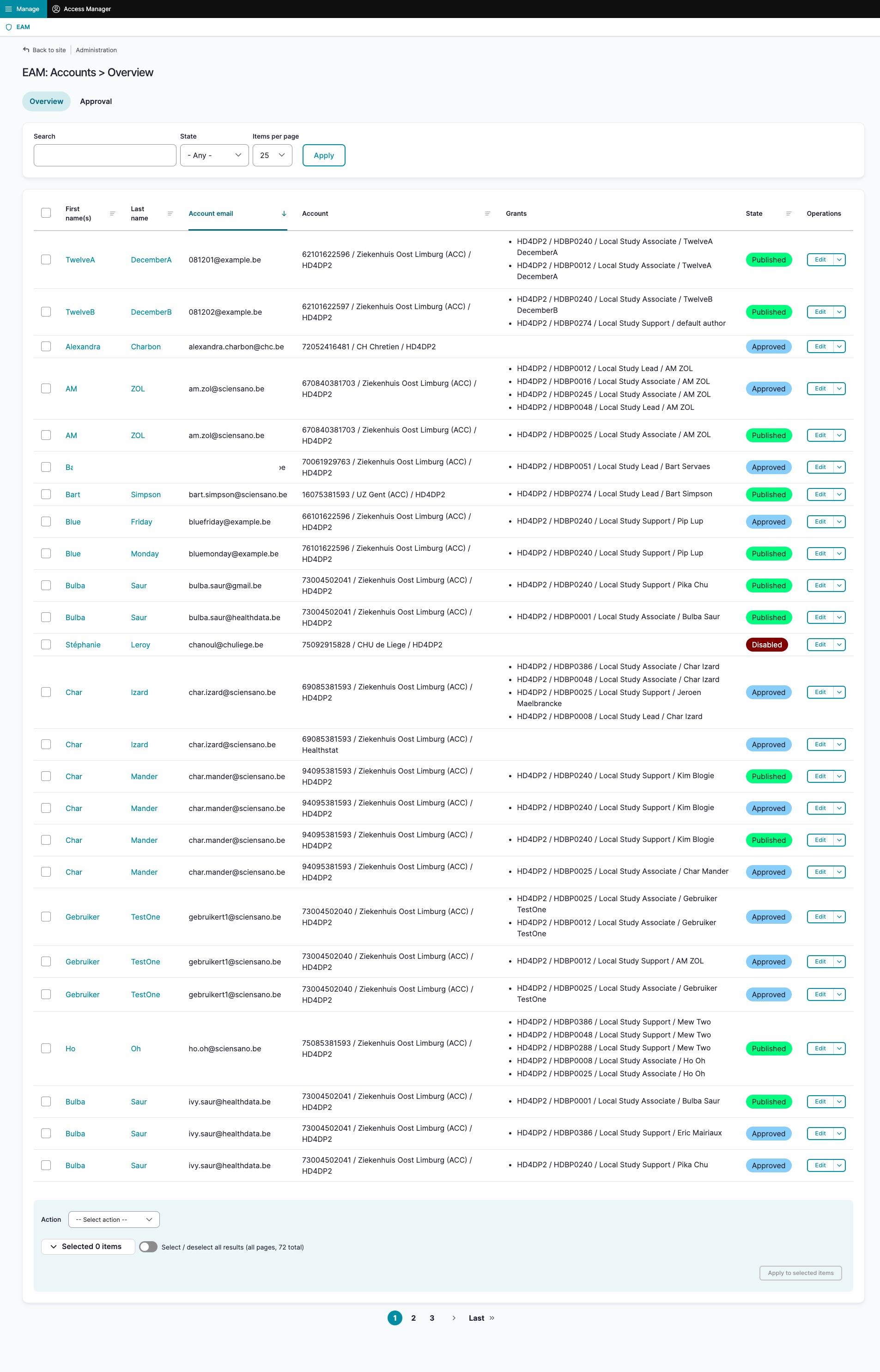
You will now see an overview of all accounts of all users within the organization(s) for the different applications, including the grants.
Attention
From EAM version 3.1 onward the grants on the Accounts overview page will be shown collapsed by default, if an account has more than 1 grant. For example:

Filtering accounts on HD4DP2
Use "CTRL+F" and enter "HD4DP2" in order to find the accounts for the application HD4DP2.
Return to the User Matrix (recommended)
Viewing the accounts for own projects
Preceding steps
Viewing own accounts for the different applications
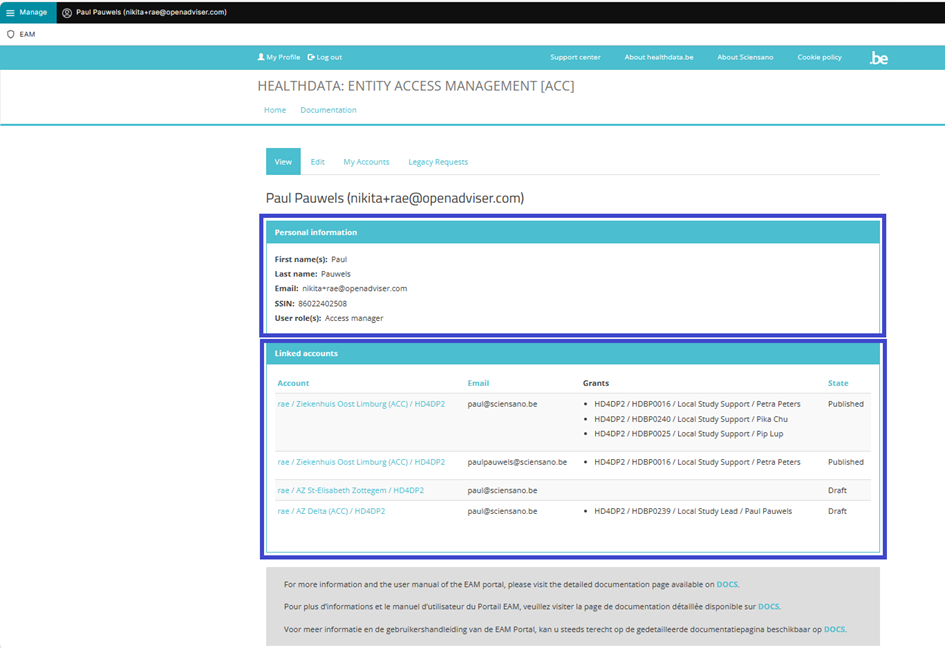
Go to the Linked accounts section on your My profile page to view the own accounts for the different applications.
Filtering accounts on HD4DP2
Use "CTRL+F" and type "HD4DP2" in order to find the accounts for the application HD4DP2.
Return to the User Matrix (recommended)
This documentation is being updated regularly. We try to provide as correct, complete and clear as possible information on these pages. Nevertheless, if you see anything in the documentation that is not correct, does not match your experience or requires further clarification, please create a support ticket via our portal Jira Service Management or send us an e-mail via support.hd@hda.fgov.be to report this documentation issue. Please do not forget to mention the URL of the page. We will then adjust the documentation as soon as possible. Thank you!Access Manager actions for a project in Healthstat.be using the EAM interface
Access Manager actions for a project in Healthstat.be using the EAM interfaceTable of contents
- Adding access grants with the role of Data Provider/Hospital, Data Provider/Individual, Sponsor/Sponsor or Sponsor/Individual
- Requesting approval of access grants with the role of Data Provider/Hospital, Data Provider/Individual, Sponsor/Sponsor or Sponsor/Individual
- Approving access grants with the role of Data Provider/Hospital, Data Provider/Individual, Sponsor/Sponsor or Sponsor/Individual
- Disabling an EAM account
- Restoring an EAM account
- Resetting the password of an EAM account
- Viewing the EAM accounts of all participants to all projects in healthstat.be of the own organization
- Viewing the EAM accounts for own projects in healthstat.be
Adding access grants with the role of Data Provider/Hospital, Data Provider/Individual, Sponsor/Sponsor or Sponsor/Individual
Preceding steps
Provisioning a new EAM account and adding grants for Healthstat.be
Click on Manage on the top left of the screen in order to reveal the EAM menu. Select EAM Users.
Select a user from the displayed overview for whom you want to create an account with provisioning and addition of grants. To do so, click on the corresponding First name, Last name or SSIN.
ATTENTION: Authenticated Users that not yet appear in the list have either to register via the FAS service and create an account (Authenticated User action) or have to be added via Bulk upload (Access Manager action) first.
Select the Add new Account button in the displayed My Accounts page.
In the Add a new account pop-up window you fill out a valid e-mail address and select the provision (Organization/Application) from the drop-down list. Click on the Save button to add the completed account.
To add the grants, select "n grant(s)" for the desired account.

Click on the Add new Grant button.

Select the desired Project and the Role / Data level that apply to your situation. Click on the Save button.

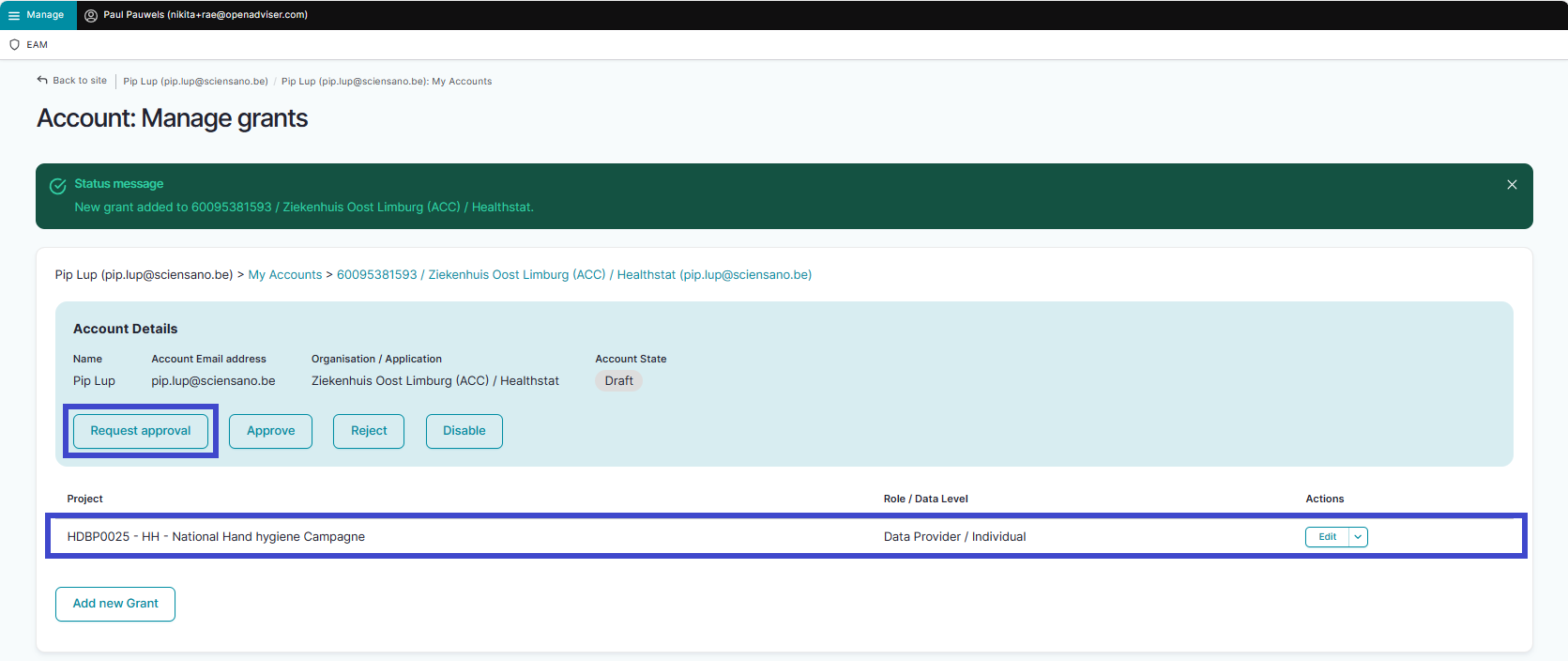
Upon returning to the Account: Manage grants page you will notice that the grant is added to your account, which is still in the Draft state.
Next step: Request Access Manager's approval of the access grants as described here.
Return to the User Matrix (recommended)
Requesting approval of access grants with the role of Data Provider/Hospital, Data Provider/Individual, Sponsor/Sponsor or Sponsor/Individual
Preceding steps
- Navigating to the HD EAM Portal and Access Manager profile
- Provisioning a new EAM account and adding grants
Requesting EAM account approval
Next step is to request approval of the newly added account with grants, thus enabling the Authenticated User to access the specified project(s) in a given application (HD4DP2, Healthstat.be ...).
Click on the Request approval button.
The status immediately changes to Approval.
The Access Manager will be notified of your request via e-mail. The Access Manager will then need to take the appropriate action. This can take multiple hours. Upon confirmation the Account state will change to Approved.
Next step: Access Manager's approval of the access grants as described here.
Return to the User Matrix (recommended)
Approving access grants with the role of Data Provider/Hospital, Data Provider/Individual, Sponsor/Sponsor, Sponsor/Individual
Preceding steps
- Navigating to the HD EAM Portal and Access Manager profile
- Provisioning a new EAM account and adding grants
- Requesting EAM account approval
Approving an EAM account approval request
Click on Manage on the top left of the screen in order to reveal the EAM menu.
Select EAM Accounts followed by Approval.
Click on Approval to open the page with end-user accounts that are waiting to be approved:
There are two ways to approve these account approval requests:
- Check the selection box of the relevant approval request and select the Approve action in the drop-down menu. Then, click on the Apply to selected item button to perform the action.
- Click on the Edit button in the Operations column for the relevant account ...
... and subsequently on the Approve button in the Account: Manage grants screen.
The Account State changes to Approved.
After this, a fulfilment process will start to run in the background, resulting in an Account State change to Published.
Performing a push action
If this change does not take place within a reasonable amount of time - usually up to three hours - the account could be updated by means of a "push".
Therefore, return to the accounts overview screen.
First, check the Approved account that needs to be pushed (1). Then, open the Action drop-down menu and select the Update account (push) option (2). Finally, validate this action by clicking on the Apply to selected items button (3).
In case the push action does not trigger the expected result, you need to contact our Support service.
Return to the User Matrix (recommended)
Disabling an EAM account
Preceding steps
Disabling an account
Click on Manage on the top left of the screen in order to reveal the EAM menu. Select EAM Accounts.
Scroll down the displayed list of accounts and tick the selection box of the account(s) you want to disable. Go to the bottom of the page and click on the Action toggle button to select Disable account. Then, click on the Apply to selected items button.


Confirm with the Execute action button.
This action triggers an e-mail to the Authenticated User to inform about the account being disabled: the user can't log in with the given credentials.
Return to the User Matrix (recommended)
Restoring an EAM account
Preceding steps
From here similar to the process as for HD4DP2
Restoring an EAM account
Sometimes the Access Manager disables an EAM account to perform corrective actions without the Authenticated User of that account being able to login to the account.
Click on Manage on the top left of the screen in order to reveal the EAM menu. Select EAM Accounts.
Next, in the overview with the accounts of the Authenticated Users, click on the Edit button of the disabled account you wish to restore.
Next, to undo the Disabled state, you need to click on the Create New Draft button.
The Account State is restored to Draft, so that the Access Manager is able to carry out the necessary corrections on this EAM account.
After having restored the Draft status, the Access Manager first needs to request for approval by clicking on the Request approval button. The approval request needs then to be approved. Click here to learn how to do this.
Return to the User Matrix (recommended)
Resetting the password of an EAM account
Preceding steps
From here similar to the process as for HD4DP2
Resetting the password of an EAM account
Click on Manage on the top left of the screen to reveal the EAM menu. Select EAM Accounts.
Scroll down the overview with the accounts and tick the selection box of the account(s) for which you want to reset the password.
Go to the bottom of the page and click on the Action toggle button to select Reset password.
To complete the action, you need to click on the Execute action button.
This action triggers an e-mail to the end-user containing the new credentials.
Return to the User Matrix (recommended)
Viewing all accounts of all users within the own organization
Preceding steps
Viewing all accounts of all users for the different applications
Click on Manage on the top left of the screen in order to reveal the EAM menu. Select EAM Accounts.
You will now see an overview of all accounts of all users within the organization(s) for the different applications, including the grants.
Attention
From EAM version 3.1 onward the grants on the Accounts overview page will be shown collapsed by default, if an account has more than 1 grant. For example:
Filtering accounts for Healthstat.be
Use "CTRL+F" and type "Healthstat" in order to search the EAM accounts for projects in the application healthstat.be.
Return to the User Matrix (recommended)
Viewing the accounts for own projects
Preceding steps
Viewing own accounts for the different applications
Go to the Linked accounts section on your My profile page to view the own accounts for the different applications.
Filtering accounts for healthstat.be
Use "CTRL+F" and type "Healthstat" in order to search the EAM accounts for projects in the application healthstat.be.
Return to the User Matrix (recommended)
This documentation is being updated regularly. We try to provide as correct, complete and clear as possible information on these pages. Nevertheless, if you see anything in the documentation that is not correct, does not match your experience or requires further clarification, please create a support ticket via our portal Jira Service Management or send us an e-mail via support.hd@hda.fgov.be to report this documentation issue. Please do not forget to mention the URL of the page. We will then adjust the documentation as soon as possible. Thank you!